System Administration
Sharing Profiles
Sharing Rules are used to configure data sharing rules across users in role hierarchy. In PE Front Office, the default access for CRM records is set to public, which enables everyone to see all records. When sharing rules are set to private, users can only view records assigned to them and records of users below them in role hierarchy. Sharing Rules also help you to set custom sharing rules to share data with specific role, role and subordinate, and group.
Notes: Admin
users can view all records irrespective of roles, profiles and sharing rules
Features
Sharing Rules enables you to configure following permissions across users in PE Front Office.
|
1 |
Private |
Users
can only view records assigned to them, and records that are assigned to
users with a role below them. |
|
2 |
Public
Read only |
Everyone
can view all records but cannot modify and delete the records. |
|
3 |
Public
Read, Create/Edit |
Everyone
can view and modify all records but cannot delete the records. |
|
4 |
Public:
Read, Create/Edit, Delete |
Everyone
can view, modify and delete every one else's records. |
Configuring
Organization-Wide Sharing Rules
This
feature enables you to configure sharing rules across your organization. The
default sharing rules offered by PE Front Office are set to Public. However,
you can change the sharing rules according to your requirements.
To
configure Organization-level sharing rules, follow the below steps:
1.
Click on CRM Settings icon ( ) in the top right corner of the panel.
2. In the Users and Access Management panel, click on Sharing Access.
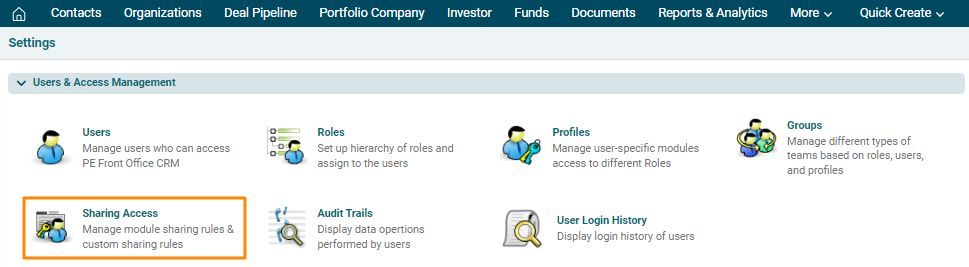
3. A
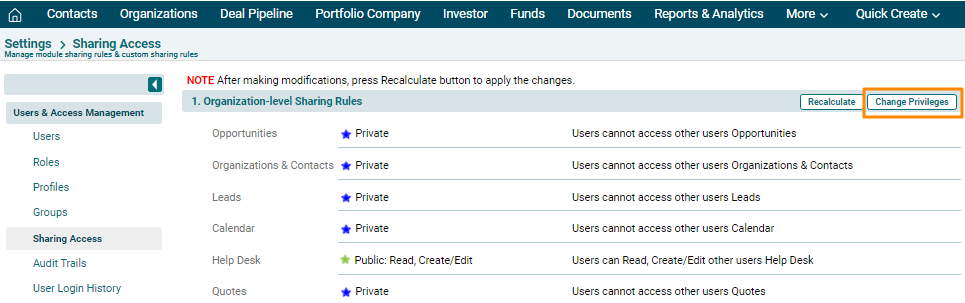
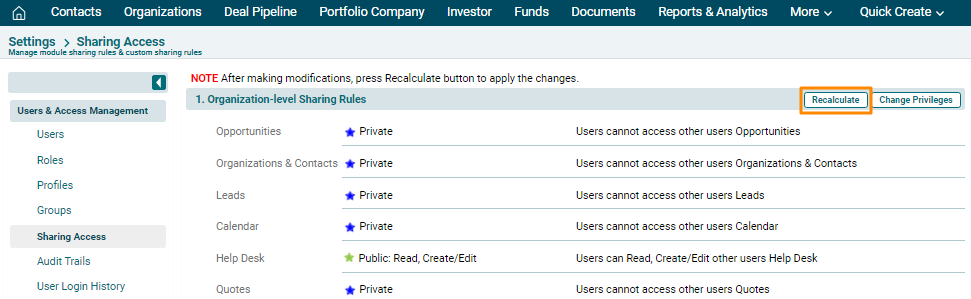
list of existing privileges will be displayed. Click on Change Privileges
button in the top right corner of the panel.
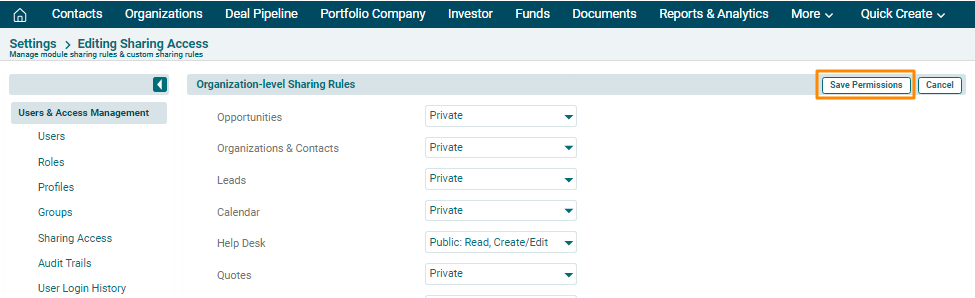
4.
Update the permissions and click Save Privileges.
5.
To apply the changes, click Recalculate button in the top right corner of the panel.
Setting Up Custom Sharing Rules
Custom sharing rules are used to allow subordinates to perform operations on superiors' records. In other words, you, as a user on upper hierarchy, can grant access to your subordinates to view your records. This can also be achieved by setting up Sharing Rules to Public, but the intention here is to only grant access to selected group, role and, role and subordinates that are below you in role hierarchy.
For instance, Sales Manager is on a role hierarchy above Sales Person. As
sharing rules are set to private, Sales Manager can view Sales Person's records
but not the other way around. Sales Manager wants to give access on his records
to his Sales Person. Now setting sharing rules to Public will let everyone view
Sales Manager's records. Setting up custom sharing rules gives Sales Manager
the flexibility to exclusively grant access to Sales Person role.
To
modify custom sharing rules, follow the below steps:
1.
Click on CRM Settings icon ( ) in the top right corner of the panel.
2.
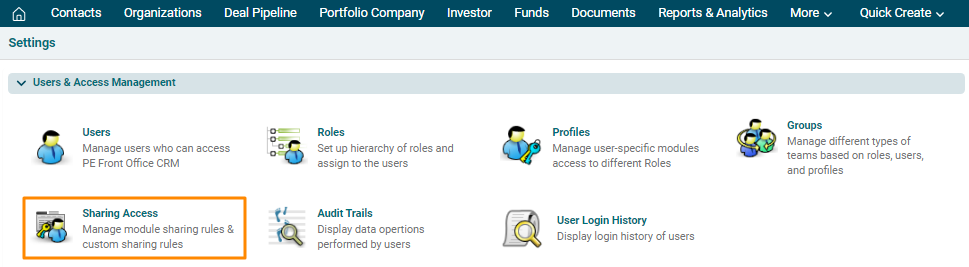
In the Users and Access Management panel, click on Sharing
Access.
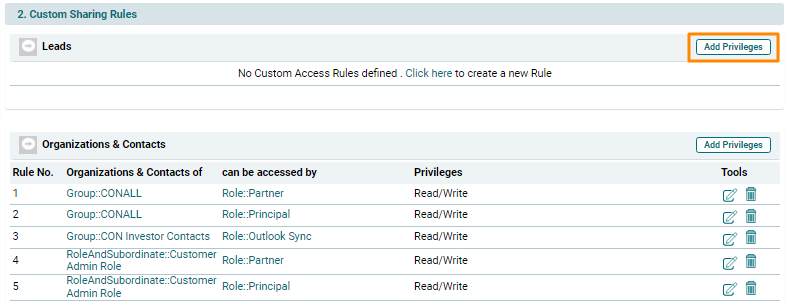
3. Click
on Add Privileges button in the top right corner of the panel.
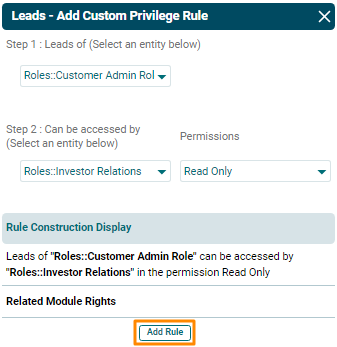
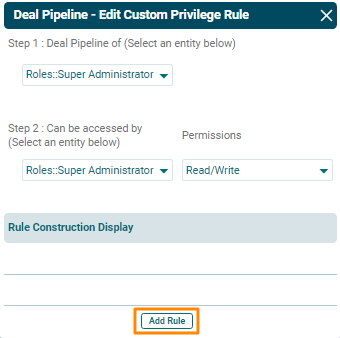
4. Update the details and click Add Rule.
5. To
edit a custom sharing rule, click on the Edit icon
( ) in the Tools column. Update the details and click on Add Rule button to save.
6. To delete a custom sharing rule, click on the Delete icon ( ) in the Actions column.
The delete window is displayed. Click OK to
delete the rule.
) in the Actions column.
The delete window is displayed. Click OK to
delete the rule.